
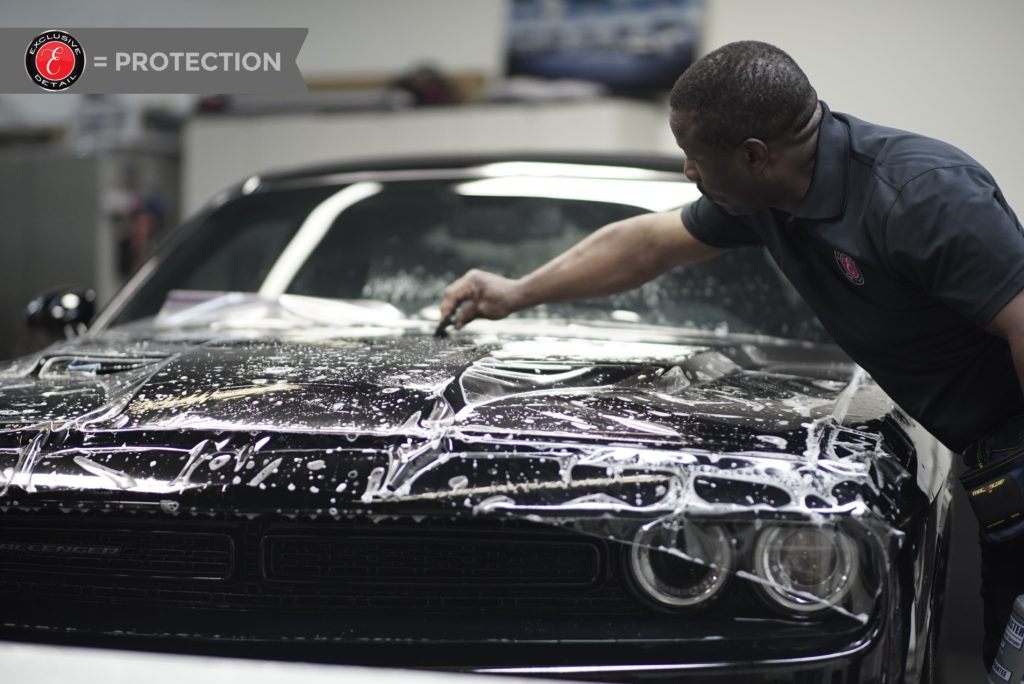
You want to keep your new car looking as good as or better than it did the day you bought it. And if you’re looking to do that, you probably know that Paint Protection Film (also called PPF, Clear Bra, Car Wraps, or Vinyl Wraps) is the most comprehensive form of protection you can apply to your vehicle to protect it from rock chips, small scratches, chemical stains, and a host of other environmental contaminants.
That’s great! But now you have to decide which specific film is right for your car. And that question can be a foggy one. Maybe you’ve read some forum debates about XPEL vs. 3M or you’ve heard about other companies like SunTek and LLumar.
Well, it’s time to clear up the issue. We are going to give you an inside review of the similarities and differences between three different films: XPEL Ultimate Plus, LLumar Platinum (also sold as SunTek Ultra), and 3M Scotchgard Pro Series.
What Areas Can You Protect with Clear Bra Paint Protection Film (PPF)?
One of the greatest advantages of modern Paint Protection Film (PPF), whether LLumar Platinum, XPEL, or 3M, is its versatility. Coverage is not one-size-fits-all; it can be customized to match your driving habits, environment, and the level of protection you want for your vehicle.
Here are the most common areas discerning owners choose to shield with PPF:
Front Bumper – Your first line of defense against stone chips, road debris, and insect acids.
Hood (Full or Partial) – Protects against grit and bug impacts, maintaining clarity across one of the largest exposed panels.
Fenders – Especially the front fenders, which endure significant road spray and debris.
Side Mirrors – Constantly exposed “wings” that easily pick up scratches, nicks, and UV wear.
Headlights & Fog Lights – Preserves clarity, prevents hazing, and avoids costly replacements.
Rocker Panels – Shields the lower body from debris kicked up by your own tires.
Door Edges & Handles – Protects against scratches from keys, rings, and repeated contact.
A-Pillars & Roof Leading Edge – Adds coverage for high-impact areas near the windshield.
Whether you choose full-front coverage (a popular option for Tesla, Porsche, and other sports car owners) or targeted protection for high-risk zones, PPF adapts to your needs. With today’s self-healing films, you’ll enjoy a virtually invisible barrier that keeps your paint looking showroom-new while preserving the long-term value of your automotive investment. As a PPF installer in Charlotte, NC, we help owners choose the right film and coverage for how they drive.
Similarities Between the Best Paint Protection Films: XPEL, LLumar/SunTek, 3M
Let’s start with the similarities between these films. These three films are similar in three key ways:
First, all three of these films offer high-performance protection.
They all perform at a high level to protect your car’s paint from rock chips, chemical stains, small scratches, UV damage, and whatever else nature or the road throws at your car. None of them offers bullet-proof protection. No film or product ever will. But all three of them will do a very good job and are comparable in terms of the protection they offer. All of these films are about 6 mils thick not including the adhesive. And to top it off, all of them have “self-healing” properties, which means that small scratches in the film will disappear after the film is exposed to heat.
Second, all three of these films are crystal clear after a quality installation.
There’s not much point in getting a product that protects your paint if in the process it makes your paint look terrible. The benefit of all of these films is that they are invisible to the naked eye after a quality installation. And all of these films retain their transparency very well. Previous generations of films had problems with yellowing over time, especially after extended UV exposure. The yellowing effect was actually occurring in the adhesive under the films. Since then the industry has developed superior adhesives that do not yellow over time, which means that if you get one of these films you can be confident you will have a crystal clear finish that is not susceptible to premature discoloration.
Third, all three of these films are long-lasting.
How Long Does Paint Protection Film Last?
All premium paint protection films are designed for long-lasting performance when professionally installed and properly maintained.
- 3M Scotchgard Pro – Backed by a 10-year warranty
- XPEL Ultimate Plus – Backed by a 10-year warranty
- LLumar Platinum / SunTek Ultra – Backed by a 10-year warranty
Each of these films has a strong reputation for maintaining clarity, protection, and durability throughout their warranty period. With proper care, many owners see performance extend well beyond those timelines.
No film lasts forever. Longevity depends on how the vehicle is maintained. Abuse, neglect, or exposure to harsh conditions can shorten the life of PPF. By contrast, regular care with the right products and techniques can significantly extend its performance.
Keys to Maximizing PPF Longevity
- Wash regularly with film-safe, pH-neutral products
- Avoid harsh chemicals or abrasive cleaning methods
- Inspect film periodically for wear or damage
- Consult your installer for proper maintenance guidance
With XPEL-certified installation and consistent upkeep, PPF provides years of peace of mind, protecting your vehicle’s finish and preserving its value well beyond the life of the warranty.
What You Need in a Paint Protection Film: XPEL, LLumar/SunTek, and 3M all have it
Before we get into the differences between these films, we should stop and say that those three items I mentioned above are the most important factors in a Paint Protection Film. You want a film that will protect at a high level, that will not inhibit the appearance of the paint, and that will last for a long time. If you get a film that does all three of those things, you have a win-win-win. As we’ve said, all three of these films do all three of those things very well; which is to say, you can be a happy customer with any of these choices.
Nonetheless, some differences between these films may make one better for you than the others. So let’s get into the specifics of each film.
The Best Paint Protection Film? XPEL, LLumar/SunTek, 3M Reviews
XPEL Ultimate
XPEL is the most recognized name in the paint protection film industry, and for good reason. They launched the world’s first self-healing PPF, and the technology they developed became the standard that every other manufacturer now follows. That kind of innovation doesn’t happen by accident.
Today, XPEL offers two flagship films: Ultimate Plus and Ultimate Fusion.
Ultimate Plus is XPEL’s clear, high-gloss film. It delivers exceptional optical clarity, strong self-healing performance, and impact resistance that independent installers consistently rank at the top of the category. For luxury vehicles, performance cars, and exotics, it is the film most certified installers reach for first.
Ultimate Fusion takes things further. It includes a ceramic coating infused directly into the film’s topcoat, giving it built-in hydrophobic properties that repel water, dirt, and road grime without requiring a separate ceramic application. More on why that matters in a moment.
Beyond the film itself, XPEL’s DAP (Design Access Program) is the largest pattern database in the industry, containing over 120,000 precision-cut kits covering virtually every make and model on the road. Better patterns mean better fitment, cleaner edges, and more consistent results on complex vehicles. Installers who have worked with multiple software systems consistently call DAP the strongest available.
One more differentiator worth knowing: XPEL’s 10-year warranty is fully transferable to subsequent owners. That adds real, tangible value at the point of resale or trade-in, which no other brand on this list matches.
At Exclusive Paint Protection, we are XPEL-certified and install both Ultimate Plus and Ultimate Fusion. We came back to XPEL after a period installing other brands because the pattern system, the transferable warranty, and the arrival of Ultimate Fusion collectively make it the strongest overall package for our clients in Charlotte and Lake Norman.
LLumar Platinum / SunTek Ultra
As we’ve already mentioned, the LLumar Platinum Paint Protection Film and SunTek Ultra are the same in composition, just sold under two different brands. Eastman Chemicals owns both companies, and both LLumar and SunTek are significant players in the window tint industry, in addition to Paint Protection Film.
Optical clarity and finish between LLumar/SunTek and XPEL are comparable. Installation quality matters more than brand when it comes to final appearance, so this shouldn’t be the deciding factor either way.
The distinction LLumar and SunTek have historically held over XPEL’s standard film is the hydrophobic topcoat built directly into the film. It repels water and makes the vehicle easier to clean without needing a separate ceramic coating. That was a genuine advantage when XPEL only offered Ultimate Plus.
That advantage no longer stands. XPEL’s Ultimate Fusion now includes the same ceramic-infused hydrophobic topcoat natively. And for clients who choose Ultimate Plus, a professional ceramic coating applied on top delivers the same result. Either path gives you a fully hydrophobic finish.
LLumar and SunTek remain quality films backed by reputable manufacturers. If your local installer specializes in them and has years of experience with those products, you will get a solid result. We simply no longer install them, and the reasons come down to XPEL’s pattern system and the transferable warranty, two things that directly benefit our clients.
3M Scotchgard Pro
3M is the grandfather company of the entire automotive paint protection film industry. The whole technology for automotive Paint Protection Film was developed by 3M in partnership with the US military during the Vietnam War, because the military needed a lightweight way to protect helicopter blades from getting damaged. 3M developed the urethane film technology that evolved to protect NASCAR vehicles on the track and then any consumer automobile on the road. So 3M has been in this game the longest, and they have a good track record of creating quality film.
Their Scotchgard Pro Series now carries a 10-year warranty, matching the rest of the premium field. 3M’s adhesive technology is strong, and their film performs reliably on a wide range of vehicles. For fleet applications or daily drivers where budget is a primary consideration, 3M remains a respected option.
Where 3M trails the field: they do not offer a built-in hydrophobic topcoat, so you’ll want a ceramic coating on top to get that performance. Self-healing is also slower compared to XPEL under identical conditions. And the warranty, unlike XPEL’s, does not transfer to subsequent owners.
As we mentioned earlier, 3M Scotchgard Pro has what you need in a quality Paint Protection Film: high-performance protection, invisible finish, and longevity. So if you go with 3M, you will get a quality film.

Which Paint Protection Film is Best for You and Your Car?
You’ll notice in our reviews above that we didn’t necessarily answer the question in the previous header. We didn’t definitively say which Paint Protection Film is “best.” That’s because there isn’t an unequivocally, unilaterally “best” Paint Protection Film. You may choose to go with any of these brands, and you would be happy with any of the choices.
So before you decide, let me put your mind at ease: You can’t go wrong choosing between XPEL, LLumar, SunTek, or 3M. You can go wrong with other films but are safe with one of these brands. With any of them, you will get stalwart protection you’ll never see for years, and that’s what’s important.
Nonetheless, here are a couple of questions you can ask yourself to arrive at a decision.
First, what’s important to you in a manufacturer?
Do you want the most prominent company that has been in the industry the longest? That would be 3M. Do you want the company that pioneered self-healing technology, built the largest pattern database in the industry, and offers a transferable warranty? That would be XPEL. LLumar and SunTek sit in the middle, with solid reputations and strong manufacturer backing through Eastman Chemical.
Second, are hydrophobic properties significant to you?
If your car is an everyday driver and you wash it every couple of weeks, a hydrophobic surface makes a real difference in how easy maintenance is. Here’s the current picture: XPEL Ultimate Fusion has the hydrophobic ceramic coating built directly into the film. XPEL Ultimate Plus, paired with a professional ceramic coating on top, delivers the same result. LLumar and SunTek have the hydrophobic topcoat built in natively. 3M does not offer this built in, so a separate ceramic coating is needed.
In short, any of these films can give you a hydrophobic finish. The path to get there just varies by product.
Third, what does your reputable installer use or recommend?
A Paint Protection Film (PPF) installation is only as effective as the skill and attention of its installer. Even if you choose the highest quality film available, an installation that results in unsightly blisters, bubbles, or premature peeling will render it ineffective. While no installation can guarantee perfection, there is a stark contrast between a carefully executed installation by a true professional and a hasty job performed with little care.
To ensure your vehicle receives the best protection possible, seek out a reputable PPF installer in your area. Look at their dedication to the industry. Do they stay current with the latest techniques? Check their portfolio; high-resolution images of previous installations tell you more than any review. Read customer feedback to gauge consistency.
Once you’ve found an installer who earns your trust, ask them about the films they install and why. Their reasoning will tell you a lot.
We install PPF in Charlotte, NC. (Schedule an appointment here.)
Not All Paint Protection Films Install the Same Way
One of the most important and often overlooked factors in Paint Protection Film (PPF) is how it installs. Each brand has unique flexibility, tack, and pattern resources that affect the final result.
At Exclusive Paint Protection, we install XPEL Ultimate Plus and XPEL Ultimate Fusion using XPEL’s DAP (Design Access Program), the largest pattern database in the industry with over 120,000 precision-cut kits. DAP provides precision-cut templates tailored to each vehicle’s make and model, ensuring perfect coverage, clean edges, and seamless alignment with factory design lines. This technology allows our XPEL-certified team to deliver a flawless fit that honors both the look and the performance of your vehicle. Installers who have worked with multiple pattern systems consistently call DAP the strongest in the field, and XPEL’s own data shows it reduces installation time by up to 25% while improving accuracy.
That’s why the installer’s familiarity and expertise with a specific brand matters so much. A specialist who works extensively with XPEL and its DAP system will achieve better results with XPEL films than a generalist who splits time across multiple brands. The key is pairing a high-quality film with an installer deeply experienced in that brand’s tools and application techniques.
Can You Install Clear Bra PPF Over Existing Paint Damage?
It’s a common question: can Paint Protection Film (PPF) be applied to a vehicle that already has chips, scratches, or other imperfections?
Here’s the truth: while PPF is outstanding at preventing future damage, it is not designed to correct or conceal existing flaws. Applying film over chips or scratches won’t hide them. In fact, some blemishes may appear more pronounced once covered. Additionally, compromised surfaces can interfere with proper adhesion, increasing the risk of bubbling or lifting over time.
That’s why professional preparation is essential. At Exclusive Paint Protection, we recommend addressing imperfections before installation. This may involve:
- Paint correction to remove swirls and minor defects
- Touch-up work for small chips or scratches
- Panel respray in cases of more significant damage
By ensuring a flawless surface first, your PPF will not only adhere properly but also showcase a pristine finish beneath its invisible shield.
The best time to apply PPF is when your vehicle is new (or “new-to-you”), preserving that showroom finish from day one. By locking in perfection early, you gain long-term peace of mind knowing your investment is protected against whatever the road brings.
What Is Ceramic Coating, and How Does It Work with Clear Bra PPF?
If you’ve been researching premium vehicle care, you’ve likely come across ceramic coating. But what exactly is it, and how does it complement your Paint Protection Film (PPF), often called a “clear bra”?
Ceramic coating is a liquid polymer, professionally applied to your vehicle’s surface, that chemically bonds to the paint. The result is a durable, ultra-slick protective layer that enhances gloss, repels water, and resists environmental contaminants. Think of it as a long-lasting shield that amplifies both protection and beauty.
Key Benefits of Ceramic Coating
- Provides a deep, radiant gloss that outshines traditional waxes
- Adds resistance to chemicals, UV rays, and minor scratches
- Hydrophobic properties make washing faster and easier
- Preserves paint clarity and prevents fading over time
How It Works with PPF
Ceramic coating isn’t limited to bare paint. Applied over premium PPF brands like XPEL Ultimate Plus, LLumar Platinum, or 3M, it:
- Boosts surface slickness, helping your film stay cleaner longer
- Enhances gloss or matte finishes without altering film characteristics
- Makes maintenance effortless with less dirt and water adhesion
- Extends the life of your film while providing an added layer of protection
For the detail-oriented, coatings can also be applied to wheels, trim, chrome, and even interiors (leather, vinyl, and plastics) for comprehensive preservation.
Should You Pair Ceramic Coating with PPF?
Absolutely. PPF provides impact resistance against rock chips and road debris, while ceramic coating adds ease of maintenance, enhanced appearance, and extended longevity. Many discerning owners choose this combination as the ultimate preservation system. If you choose XPEL Ultimate Fusion, the hydrophobic ceramic layer is already built into the film itself. For clients who want even more coating depth and longevity, adding a standalone ceramic application on top remains an option. Either way, the result is a vehicle that stays cleaner, looks better, and requires far less effort to maintain.
Can You Apply Ceramic Coating to Both the Exterior and Interior Parts of Your Vehicle?
Absolutely. Ceramic coatings aren’t limited to your vehicle’s paintwork or Paint Protection Film (PPF). While their hydrophobic properties are widely known for making exterior maintenance effortless, ceramic coatings are highly versatile and can protect a wide range of surfaces.
Exterior Applications
Ceramic coatings bond to multiple exterior surfaces, adding gloss, durability, and resistance to contaminants on:
- Body panels & hoods
- Windshields & glass
- Trim pieces
- Wheels & calipers
- Chrome or polished accents
Interior Applications
The benefits extend inside your vehicle as well. Ceramic coatings help defend against UV damage, stains, and premature wear on high-touch areas such as:
- Dashboards & consoles
- Leather and fabric seats
- Door panels & armrests
- Interior trim pieces
Why It Matters
By creating a durable, invisible layer of defense, ceramic coatings preserve both exterior brilliance and interior refinement, ensuring your vehicle looks newer, longer. For owners who care about the full picture, it’s a smart investment that enhances protection, simplifies upkeep, and safeguards every detail of your vehicle.